Tel: +86-0731-88672086 E-mail: info@great-pipe.com
- All
- Product Name
- Product Keyword
- Product Model
- Product Summary
- Product Description
- Multi Field Search

Views: 6 Author: Site Editor Publish Time: 2026-06-08 Origin: Site
Steel pipes are vital to the oil and gas industry, with API 5L and API 5CT serving as two of the most critical standards. Although the American Petroleum Institute develops both, they serve fundamentally different purposes. Understanding this distinction is essential for ensuring project safety, regulatory compliance, and cost efficiency.
API 5L governs line pipe used in pipeline systems for transporting oil, natural gas, and water over long distances. Its design prioritises internal pressure resistance, weldability, and efficient fluid transportation. Conversely, API 5CT covers casing and tubing used directly within oil and gas wells during drilling and production. These pipes must endure harsh downhole conditions, including extreme external collapse pressure, tensile loads, and corrosive environments.
Because their operating environments differ significantly, these specifications utilise distinct grade designations (e.g., X70 for API 5L vs. P110 for API 5CT) and testing requirements. Selecting the wrong specification can lead to severe operational risks or unnecessary project costs. A pipeline-grade pipe may fail under wellbore stresses, while using premium OCTG for standard transport inflates budgets without added benefits.
What Is API 5L?
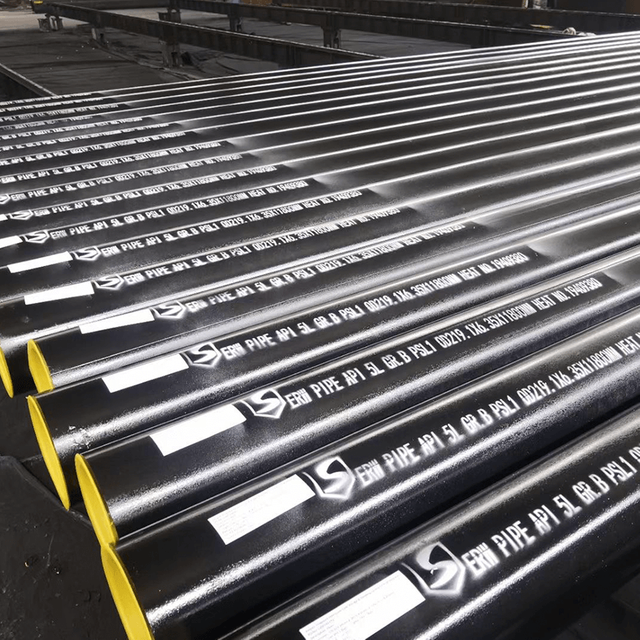
API 5L is the internationally recognised specification developed by the American Petroleum Institute for steel line pipes used in pipeline transportation systems. It establishes strict manufacturing, testing, and inspection requirements to ensure the safe and efficient transport of oil, natural gas, water, and other fluids across vast surface and underground networks.
The standard covers both seamless and welded pipe types (including ERW, LSAW, and SSAW). A key feature of API 5L is its grading system, which includes grades such as Grade B, X42, X52, X65, X70, and X80. The "X" designation indicates the minimum yield strength in ksi; higher grades offer greater strength, allowing for thinner walls or higher operating pressures.
Additionally, API 5L defines two product specification levels: PSL1, which provides standard quality for general applications, and PSL2, which enforces stricter chemical, mechanical, and toughness controls for critical projects. To withstand harsh environments, these pipes are often supplied with protective coatings like FBE, 3LPE, or 3LPP.
Widely applied in oil and gas transmission, petrochemical facilities, and offshore infrastructure, API 5L remains the foundational standard ensuring the structural integrity and reliability of global energy pipelines.
What Is API 5CT?
API 5CT is the American Petroleum Institute specification for Oil Country Tubular Goods (OCTG), specifically designed for drilling, well construction, and hydrocarbon production. Unlike pipeline pipes, API 5CT products are engineered to withstand extreme downhole conditions, including high pressures, tensile loads, and corrosive environments.
The standard covers three primary categories: casing (to stabilise wellbores and isolate geological zones), tubing (to transport fluids from the reservoir to the surface), and couplings. To accommodate varying depths and harsh conditions, API 5CT offers diverse steel grades such as J55, N80, L80, and P110, each providing specific mechanical properties and corrosion resistance.
A critical distinction of API 5CT is its emphasis on threaded connections—such as STC, LTC, and BTC—which must maintain reliable sealing and structural integrity under severe installation stresses. Furthermore, the specification mandates rigorous quality control, including hydrostatic testing, dimensional inspection, and non-destructive examination.
Widely utilised in onshore, offshore, and deep-well energy projects, API 5CT remains the foundational industry standard ensuring the safety, reliability, and long-term integrity of global oil and gas operations.
Key Differences Between API 5L and API 5CT
Comparison Criteria | API 5L (Line Pipe) | API 5CT (OCTG) |
Application Purpose | Designed for pipeline transportation systems to move fluids over long distances. | Designed for drilling, well construction, and hydrocarbon extraction operations. |
Mechanical Requirements | Focuses on internal pressure resistance, toughness, and weldability for safe transport. | Must withstand complex loads, including burst, external collapse, and high tensile forces. |
Connection Methods | Typically joined via field welding during pipeline construction. | Utilises threaded connections (e.g., STC, LTC, BTC) requiring reliable sealing under stress. |
Grade Designations | Identified by yield strength levels (e.g., Grade B, X42, X52, X65, X70). | Engineered for specific well-service conditions (e.g., J55, N80, L80, P110). |
Operating Environment | Operates in relatively stable surface or underground pipeline networks. | Faces extreme downhole conditions, including high temperature, pressure, and corrosive fluids. |
Testing & Manufacturing | Emphasises pipe body integrity, weld quality, and chemical composition. | Includes strict thread inspection, heat-treatment control, and connection verification. |
Interchangeability | Should not be used interchangeably with API 5CT due to differing design and safety requirements. | Substituting without engineering evaluation can cause severe operational and safety risks. |
API 5L vs API 5CT: Grade Comparison and Material Selection
Comparison Criteria | API 5L (Line Pipe) | API 5CT (OCTG) |
Grade Designations | Based on minimum yield strength in ksi (e.g., Grade B, X42, X65, X80). | Designed for well-service conditions and specific mechanical properties (e.g., J55, N80, P110). |
Strength & Loading | Focuses on internal pressure containment and pipeline reliability during fluid transport. | Engineered to withstand complex loads, including burst, external collapse, and high tensile forces. |
Corrosion Resistance | Standard grades suit general pipelines; sour service requires special chemical compositions. | Includes specialised grades like L80, C90, and T95 specifically for severe H₂S/corrosive environments. |
Material Selection Basis | Selected based on operating pressure, temperature, and pipeline transportation requirements. | Selected by evaluating well depth, reservoir pressure, corrosive elements, and mechanical loads. |
Interchangeability | Should not be substituted with API 5CT due to differing manufacturing and testing standards. | Substituting can cause inadequate collapse resistance, thread failure, or unnecessary cost increases. |
How to Choose Between API 5L and API 5CT
Selecting between API 5L and API 5CT is a critical decision in oil and gas projects, driven primarily by the intended application.
Choose API 5L if the pipe is used for long-distance fluid transportation through pipeline networks. It is optimised for internal pressure containment, toughness, and weldability, making it ideal for field-welded systems. Conversely, select API 5CT for Oil Country Tubular Goods (OCTG) such as casing and tubing used inside wells. These products are engineered to withstand complex downhole loads, including external collapse pressure, high tensile forces, and extreme temperatures.
Operating conditions and mechanical requirements further dictate material selection. While API 5L focuses on stable transport environments, API 5CT must endure harsh subsurface challenges. For corrosive well environments containing H₂S or CO₂, specialised API 5CT grades like L80, C90, or T95 are essential to prevent stress cracking. Additionally, connection methods differ significantly: API 5L relies on welding, whereas API 5CT utilises threaded connections (e.g., STC, LTC, BTC) designed for reliable downhole sealing.
Cost should only be considered after technical needs are defined. Using premium API 5CT materials for standard pipelines unnecessarily inflates budgets, while substituting API 5L line pipe in well applications poses severe safety and reliability risks. Ultimately, always align your material choice with specific project specifications, operating environments, and industry standards to ensure safe, compliant, and cost-effective operations.
Our Recommended API 5L and API 5CT Products and Global Shipping Services
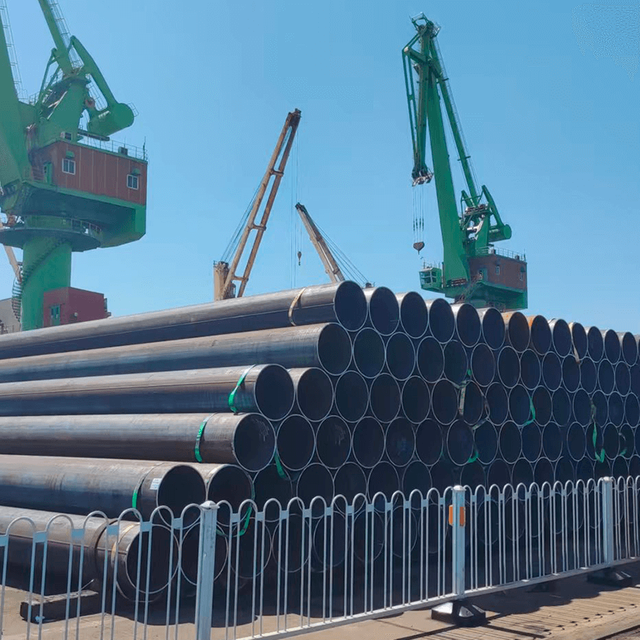
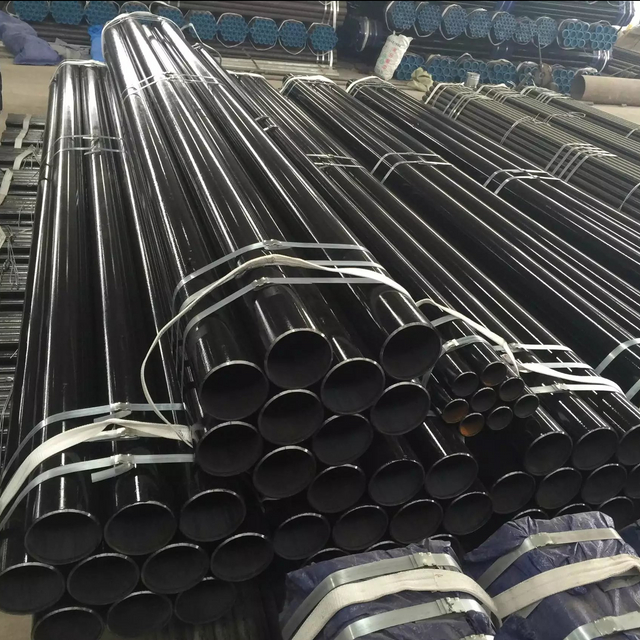
We provide a comprehensive one-stop supply solution for API 5L line pipe and API 5CT OCTG products, tailored to meet global oil and gas project requirements. Our API 5L portfolio includes seamless, ERW, LSAW, and SSAW pipes (Grades B to X80) with protective coatings like FBE and 3LPE for pipeline transportation. For drilling operations, we supply premium API 5CT casing and tubing (J55 to P110) featuring standard STC, LTC, and BTC threaded connections.
Quality is our priority. All products undergo rigorous testing, including hydrostatic pressure, tensile, and non-destructive examinations. We also support third-party inspections by SGS, BV, or TÜV, providing complete Mill Test Certificates for full traceability. To optimise your project efficiency, we offer value-added processing services such as custom cutting, beveling, threading, and anti-corrosion treatments.
Backed by professional global logistics, we ensure safe worldwide delivery through secure export packaging and flexible shipping options, including container, breakbulk, and bulk vessel transport. From precise material selection to seamless customs clearance documentation, we deliver reliable, cost-effective steel pipe solutions to keep your energy projects on schedule.
Conclusion
API 5L and API 5CT are complementary yet fundamentally distinct steel pipe specifications. API 5L is designed for pipeline transportation systems, focusing on weldability, toughness, and long-distance fluid transmission (e.g., Grades X65, X70). Conversely, API 5CT governs Oil Country Tubular Goods (OCTG) like casing and tubing, engineered to withstand extreme downhole pressures, mechanical loads, and corrosive environments during drilling and production (e.g., N80, P110).
Crucially, similar strength levels do not make these products interchangeable. Substituting one for the other can lead to severe safety risks, operational failures, and regulatory non-compliance. Successful material selection requires aligning the specific standard with the project's exact application, operating conditions, and connection requirements. By understanding these differences, engineers ensure optimal performance, cost efficiency, and long-term asset reliability in global energy projects.
FAQ:
(1) What is the main difference between API 5L and API 5CT?
API 5L is used for pipeline transportation, while API 5CT is used for oil and gas well drilling and production.
(2) Can API 5L pipe be used as casing pipe?
Generally not, because API 5CT casing requires specific mechanical and connection performance.
(3) Which specification has higher strength grades?
Both have high-strength grades, but they are designed for different service conditions and cannot be compared directly.
(4) Is API 5CT more expensive than API 5L?
In many cases, yes, due to stricter requirements, threading, and downhole performance demands.